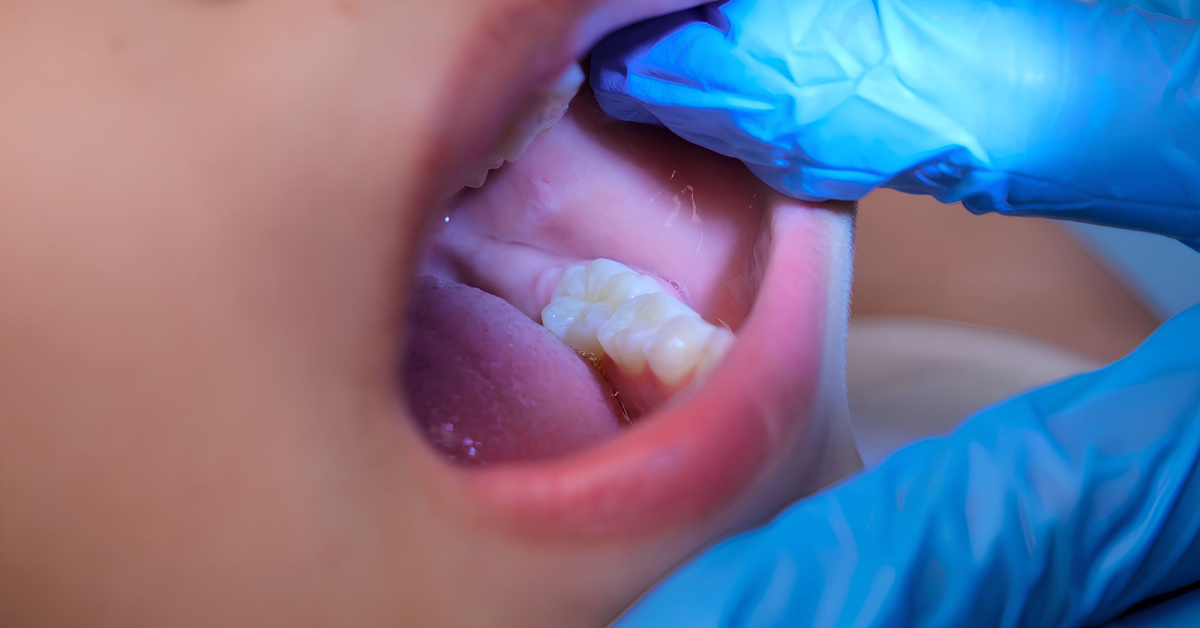
There is no tooth fairy moment for this one. No wiggling for a week at the dinner table, no gap in the smile, no small ceremony involving a pillow and a dollar. Somewhere around your child’s sixth birthday, a large tooth simply appears at the very back of the mouth, and most parents do not find out it is there until a hygienist points it out.
That quiet arrival is the whole problem. Every other permanent tooth announces itself by pushing a baby tooth out first, which gives parents a clear signal that something adult and irreplaceable has taken its place. The 6-year molars skip that step entirely. They erupt behind the last baby molar, into space that was empty before, and they look enough like the teeth around them that parents assume they are part of the same temporary set.
They are not. And by the time a cavity shows up on one, a child has often been treating a permanent tooth like a disposable one for two or three years.
What follows is the full picture: when each set of molars arrives, why the first ones matter more than any other tooth in a child’s mouth, what makes them uniquely vulnerable, and what Dr. Ken Otterstedt at Otter Kids Pediatric Dentistry actually does to protect them.
Are 6 Year Molars Permanent? The Question Behind a Lot of Missed Cavities
Yes. Completely, permanently, no-second-chances permanent.
This is the single most common misunderstanding Dr. Ken corrects in the exam room, and it is easy to see why it happens. At age six, a child’s mouth is mostly baby teeth. Nothing about the new molar in the back looks different from its neighbors to an untrained eye. Parents reasonably assume it will fall out like everything else eventually does.
Are 6-year molars permanent even though they show up so early? Yes, and that early timing is exactly what makes the confusion costly. When a parent believes a tooth is temporary, the calculus around it changes. A small brown spot feels less urgent. Skipping the back teeth during a rushed bedtime brushing feels harmless. A tooth that will be gone in a few years does not seem worth a fight.
That tooth needs to last another seventy or eighty years.
When Do Permanent Molars Come In? The Full Timeline
Children get three sets of permanent molars, and none of them replace anything. Each one erupts into new space at the back of the arch as the jaw grows longer, which is why the mouth can accommodate them without anything falling out first.
First permanent molars: ages 6 to 7
The first permanent molars usually erupt between six and seven years old, one in each quadrant, directly behind the second primary molar. The lower ones typically come in slightly ahead of the upper ones. In many children, they arrive around the same time the lower front baby teeth start loosening, which means there is a lot of visible activity at the front of the mouth drawing attention away from the back.
Second permanent molars: ages 11 to 13
The second set, often called the 12-year molars, erupts behind the first. By this point, most of the primary teeth have been shed and replaced, so the arrival of these molars marks the point where the mouth is close to its adult configuration. These permanent molars carry the same deep-groove vulnerability as the first set and deserve the same preventive attention.
Third molars: late teens
Wisdom teeth begin forming under the gums in the mid-teens and erupt somewhere between seventeen and twenty-one, when they erupt at all. Some people never develop them. Many do not have the arch length to accommodate them, which is why they are so frequently removed. Dr. Ken tracks their position on radiographs through adolescence and will tell you early whether they are likely to become a problem.
The Tooth That Sets the Blueprint for the Whole Bite
Here is the part that rarely makes it into a parent conversation. The first permanent molars do more than chew. They establish the reference point that the rest of the permanent dentition builds against.
When the upper and lower first molars meet, their relationship determines how every tooth in front of them lines up. Orthodontists classify bites primarily by that molar relationship. It is the anchor for arch length, the landmark for planning treatment, and the reason a first molar lost in childhood creates orthodontic consequences that go far beyond the missing tooth itself.
Lose one early, and the teeth behind it drift forward into the space. Arch length shortens. Teeth that have not erupted yet arrive to find their room already occupied and come in rotated, blocked out, or impacted. A single decayed molar at age eight can turn into years of orthodontic work at age thirteen. That is the strongest argument for protecting these teeth aggressively rather than waiting to see what happens.
Why First Permanent Molars Are the Most Cavity-Prone Teeth in the Mouth
Multiple factors converge on these particular teeth at the same time, and each one compounds the others.
The grooves are deeper than a toothbrush bristle.
The chewing surface of a molar is not flat. It is a landscape of pits and fissures, and some of those fissures are narrower than a single bristle and deeper than the enamel itself is thick. Food debris and bacteria settle into them and stay there. No amount of brushing technique reaches the bottom of a deep fissure, which is why the overwhelming majority of childhood cavities in permanent teeth occur on these surfaces rather than between teeth.
They arrive during the worst possible brushing years
A six-year-old does not have the manual dexterity for thorough brushing, and most six-year-olds have stopped accepting help. The new molar sits farther back than anything they have had to reach before, behind a full row of baby teeth, in the part of the mouth that gets the least attention and the least light.
Partial eruption creates shelter.
A molar takes weeks or months to fully emerge. During that stretch, it sits partially covered by a flap of the gum tissue called an operculum. Plaque tends to accumulate underneath that flap; the toothbrush cannot get beneath it, and the tooth is at its most vulnerable during exactly the period it is hardest to clean.
The enamel is not finished yet.
Newly erupted enamel is not fully mineralized. It continues hardening for roughly the first two years after eruption, drawing minerals from saliva and any topical fluoride it encounters. This is why the window right after eruption is both the highest-risk period and the highest-return period for prevention.
When the Enamel Arrives Flawed: Molar Incisor Hypomineralization
Some first permanent molars come in already compromised, and this is worth knowing about because parents often mistake it for staining or poor hygiene.
Molar incisor hypomineralization, usually shortened to MIH, is a developmental defect in which the enamel of one or more first molars, and often the permanent front teeth, forms with reduced mineral content. It shows up as sharply bordered creamy-white, yellow, or brown patches on the tooth. The enamel is softer than normal, so it can crumble under normal chewing forces, and affected teeth are frequently sensitive to cold, to brushing, and sometimes to air.
The cause is not well understood and appears to involve several factors during the years those teeth are forming. Reported prevalence varies enormously between studies and populations, from a few percent to well over a third of children, so I would treat any single figure with caution.
What matters practically: MIH teeth decay faster, they are harder to numb for treatment, and fillings do not bond to them as reliably. Catching them early changes the management plan entirely, which is another reason a checkup right around the six-year mark is worth scheduling deliberately rather than whenever it happens to be convenient.
What Actually Protects Permanent Molars in Kids
Sealants, applied early.
A sealant is a thin resin coating flowed into the pits and fissures of a chewing surface, filling the grooves so bacteria have nowhere to lodge. Application takes a few minutes per tooth, involves no drilling and no anesthetic, and is one of the least invasive things done in dentistry.
The evidence behind them is unusually solid. A joint panel convened by ADA and AAPD issued and endorsed a clinical practice guideline in 2016 recommending sealants over non-use on the chewing surfaces of kids’ primary and permanent molars and even in adolescents, and concluding that sealants both prevent new decay and arrest early lesions that have not yet cavitated. A CDC report from the same year put the effect at roughly 80 percent of cavities prevented over two years and about 50 percent at four years, with retention possible for as long as nine years. Those figures are from 2016, and I would verify them against current CDC material before quoting them elsewhere.
The timing matters as much as the sealant. Placed soon after eruption, while the enamel is still maturing and the grooves are still clean, they do the most work. Placed on a tooth that already has decay starting in the fissure, they do less.
Topical fluoride during the maturation window
Professional fluoride applications at checkups feed mineral into enamel that is still hardening. For newly erupted permanent molars, this is not a routine formality. It is the most useful two years fluoride will ever have on that tooth.
The flashlight check
Here is the low-tech thing that catches the most problems. Let your child brush first, then take a flashlight and look at the back molars yourself. You are looking for plaque along the gumline and food packed into the grooves. Most children this age miss both, consistently, no matter how confident they are that they did a good job. Two minutes of checking a few nights a week does more for permanent molars in kids than any product you can buy.
Radiographs at the right intervals
Decay between molars is invisible to the eye until it is substantial. Radiographs taken at appropriate intervals show what is happening on contact surfaces and beneath existing restorations, and they show the position of teeth still developing under the gum. Caught early, a lesion in a first molar is a small filling. Caught late, it is a crown, a pulp treatment, or an extraction with orthodontic consequences attached.
What Eruption Feels Like, and When to Call
Most children handle molar eruption with mild, unremarkable symptoms: soreness at the back of the jaw, a preference for chewing on the other side, slightly puffy gum tissue behind the last baby molar, occasionally a sense that something feels strange back there without being able to explain it. These typically settle within a week or two as the tooth continues to emerge, and age-appropriate pain relief is usually enough.
Some things are not routine. If the gum around a partially erupted molar becomes swollen, red, and genuinely painful, that operculum may have become infected, a condition called pericoronitis. It can make chewing and even opening the mouth uncomfortable and does not resolve on its own. Fever, facial swelling, or pain that wakes a child at night warrants a call to the office rather than a wait-and-see approach. Our emergency care page covers what to do outside regular hours.
Building Your Child’s Visit Schedule Around Molar Eruption
Protecting permanent molars in kids is largely a scheduling problem. Two ages deserve deliberate attention rather than whenever-you-remember booking.
Around five and a half to six, book a checkup specifically to catch the first permanent molars as they emerge. Dr. Ken can confirm whether they are erupting on schedule and in good position, identify any hypomineralization, and get sealants placed in that early window when they matter most.
Around eleven to twelve, book again for the second set. Same logic, same grooves, same short window.
Otter Kids sees families from across Colorado Springs, Fort Carson, Briargate, Powers, Northgate, Falcon, Flying Horse, Monument, and Manitou Springs, with a second office in Woodland Park. We accept Medicaid and most major dental plans, and for families without coverage, our membership plans make preventive visits and sealants predictable rather than something to put off.
Catch Them While They’re New
The window for protecting a first molar opens the month it erupts and starts closing almost immediately. Permanent molars are the teeth your child will chew with for the next seventy years. If your child is five, six, or seven, this is the appointment worth making on purpose.
Frequently Asked Questions
In three waves. The first permanent molars erupt around ages six to seven, the second set around eleven to thirteen, and wisdom teeth in the late teens if they erupt at all. None of them replace a baby tooth.
Yes. They are the first permanent molars, and they never fall out. Because they arrive while a child still has mostly baby teeth, parents frequently assume they are temporary, which is how decay in these teeth gets overlooked.
Because there was never a baby tooth in that spot, molars erupt into the new space created as the jaw lengthens, behind the existing primary teeth. Only the front teeth, canines, and premolars replace something that falls out first.
Yes, and soon after eruption. The 2016 ADA and AAPD clinical practice guideline recommends sealants on the chewing surfaces of children’s molars, and the protective benefit is highest when the tooth is newly erupted and the grooves are still decay-free.
Probably not. Eruption timing varies by a year or more in healthy children. Mention it at the next visit, and Dr. Ken can take a radiograph to confirm the molars are developing and positioned normally beneath the gum.
They may be molar incisor hypomineralization, a developmental enamel defect rather than a stain. Affected enamel is softer, more sensitive, and decays faster than normal enamel, so it needs a different preventive and treatment approach.
Neighboring teeth drift into the space and arch length shortens, which can crowd or block teeth that have not erupted yet. Timing of removal matters a great deal, so this is always a planned decision made alongside orthodontic considerations.
Twice yearly works for most children, though Dr. Ken may recommend more frequent visits during active eruption or if your child has a history of decay. The years between six and thirteen are the highest-yield stretch for prevention.